


It’s beautiful
“Hard to admit, but it was still beautiful.”
This sentence touched me. It’s from Ian McEwan’s latest novel, What We Can Know, which takes place in 2119. The protagonist Tom Metcalfe’s observation about a dramatically-altered English landscape reflects his nostalgia for those “resourceful raucous times, when the sea stood off at a respectful distance.”
This takes place after the Derangement; when people are looking back from the future and thinking about a past that “seems whole and precious, when many of humanity’s problems could have been solved.”
The image of the Earth taken by NASA astronaut and Artemis II Commander Reid Wiseman on April 2, 2026 reminds us that we live on an exquisite planet that is, in fact, whole, precious, and teeming with life. And full of problems that can be solved.
What if we could still rescue and recover all that we love about this beautiful planet — today?
Axial revolutions
We know what we need to do, but we are not doing it. The problem is not a lack of knowledge. The problem lies in our perspectives.
What does it mean to shift perspective? Back in 2012, I participated in a European Science Foundation project called RESCUE — short for Responses to Environmental and Societal Challenges for our Unstable Earth (RESCUE). I was co-leader of the working group, “Towards a Revolution in Education and Capacity Building.”
The working group agreed that this could not be another “circular” revolution — nothing more than continuous motion around an unchanging (and even unrecognized or invisible) axis. Round and round we go, creating an illusion of progress.
It sounded all too familiar.
Instead, we saw a need for an axial revolution that challenged unquestioned beliefs, assumptions, and paradigms. Such a revolution would address not only institutional reforms and curriculum changes, but also interior shifts in consciousness and meaning making. This revolution would help us to identify our blind spots and respond differently to environmental and social challenges.
The revolution that our working group was calling for was unconventional and daring. We invited leaders in research, education, and capacity building to engage in reflexive processes, potentially disturbing their own ‘‘axes’’ to come up with new ways of addressing the challenges posed by global environmental change.
What we learned is that transformation is both a revolutionary and evolutionary process. It involves more than endless cycles of planning, doing, checking, and acting. It requires that we shift our perspective and adopt a different point of view.
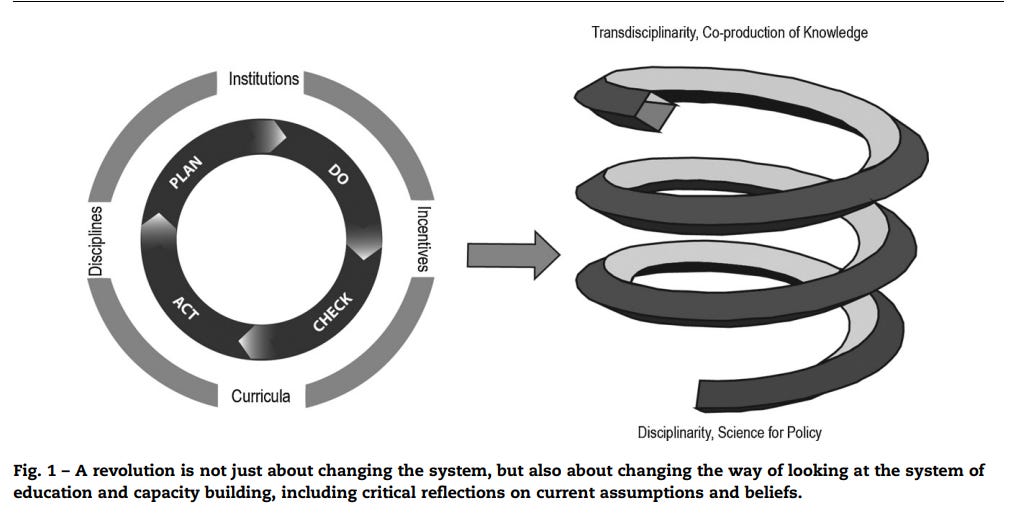
Source: O’Brien et al. (2013) “You say you want a revolution? Transforming education and capacity building in response to global change.” Environmental Science and Policy
Axial revolutions are not new. In fact, in The Three Axial Ages: Moral, Material, Mental, sociologist John Torpey distinguishes three axial ages: a moral one that left a profound mark on human self-understanding (around the middle centuries of the first millennium BCE, or Before Common Era); a material one (beginning around 1750); and a mental one that is taking place today (see Table 1).
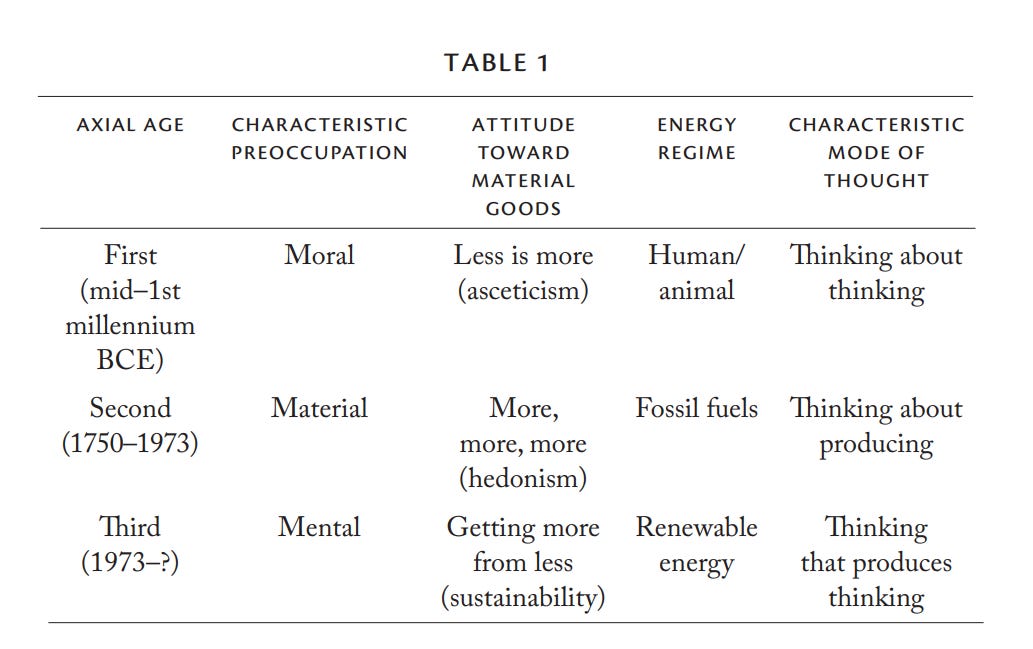
Source: Torpey (2017). The Three Axial Ages: Moral, Material, Mental. Rutgers University Press.
If the axial shift is already underway, how can I contribute to it? How can we all be part of it?
Recovery
Revolutions — whether circular or axial — involve more than rescuing ourselves from environmental and social damage and destruction. We also have to restore and regenerate the conditions for life to thrive. We need to recover.
The word recover means “to return to a normal state of health, mind, or strength.” Moving forward at a chaotic and uncertain time is easier when we are healthy, mindful, and strong, both individually and together.
This past week, I co-led a workshop in South Africa for restoration ecologists and others participating in the RECOVER project, which is a research initiative focusing on co-creating nature recovery maps to guide conservation and restoration efforts in Norway and South Africa.
cCHANGE was invited to help participants to develop their capacities for navigating and shifting social and political systems based on their inner capacities and universal values, so that we can meet sustainable development targets and care for people and the planet. This represents a paradigm shift away from the binaries and dualisms that separate us from each other and nature.
Becoming aware of our paradigms means noticing “the thinking that produces the thinking.” And this is where quantum social change comes in. In an entangled world, our thoughts and actions always influence the whole. We matter.
Uh-oh. Does this mean it’s time for me to shift my own axis? Again? Maybe this axial shift is about recovering the things that matter to me.
Recover attention. Recover focus. Recover imagination. Recover courage. Recover joy. And recover purpose.
Moving forward
Despite retiring and moving into “preferment,” I find myself going round and round, perpetuating my old ways of working. I’m still listening to the voice of reason, which tells me what I should be doing, what I could be doing, and what makes the most sense. Classical me.
This rational voice pays little attention to what I want to be doing. Which is to engage with and experience quantum social change. I want to nourish a “you matter” movement that helps us to recognize the connections between mind, meaning, and matter — and to understand why small changes make a big difference.
So how do I walk the talk in an “axial” way? For this, I need to move forward in a different way. Shifting patterns calls for both space and time. As Karen Barad points out in her work on agential realism, space, time and matter are not separate — we can instead think of our actions in terms of “entanglements of spacetimemattering.”
My first axial shift will be to recover attention and focus. Those who are recklessly destroying the world do not deserve more attention than those who are working for a better future. I will consume news with great discretion and spend more time reflecting on what matters. In times of chaos, stillness matters.
From Scraping to Thriving
The current “mental” axial revolution is significant, and the good news is that everyone can take part. We all have important roles to play. And now is the time to play these roles.
McEwan’s fictional portrayal of the current era from a future perspective makes it clear that if we continue with largely circular revolutions, we are likely to experience the situation described by the novel’s main character, Tom Metcalfe:
Round we go. Each time we fail, or calamities overwhelm us, we will come back from a slightly higher place. Rising and falling, we would continue to scrape through.
Scraping through is very different from thriving.
Rescuing and recovering the world out there is important, but the axial revolution is fundamentally about shifting our own mindsets and connecting with each other in new ways so that we can evolve together, both individually and collectively. I’m ready for the revolution. Are you?
Earth, isn’t this what you want?
To arise in us, invisible?
Is it not your dream, to enter us so wholly
there’s nothing left outside us to see?
What, if not transformation, is your deepest purpose?
- Rainer Maria Rilke
Just a reminder that the audio and pdf version of my book, You Matter More Than You Think: Quantum Social Change for a Thriving World is now freely available to all. Please share it as a small contribution to the axial revolution!
I’ve just been listening to a conversation with Martha Beck, by Sarah Wilson (her podcast is called Wild). It seems to me that the change comes from the right (brain), and more and more people are discovering this and talking about it. Martha Beck in one of her books describes things you can try for yourself to move right and get into a flow. However, I’m currently also in a period of stuckness, so maybe sometimes that’s the place to be 😊
This is shiver-inducingly close to what I’ve been tracing from my coordinates — foraging at the conjunction of poetry, permaculture, pedagogy, fiber arts, environmental sociology, and commons recovery in the US. I think the disorientation you’re describing is …topological? That’s what the word “quantum” keeps pointing to across so many fields: people bumping into a surface where the maps keep spiraling them past supposedly disconnected landmarks, and the compass doesn’t work. Then they/we reach for the one “grand” discipline that officially admits it. I’ve been calling this topology non-orientable. but I don’t love the negative frame — it names the surface by what our primary mental tools can’t do on it. The surface isn’t lacking IMO. The tools are. What if we call it porous? The inside folds into the outside, the cause folds through the effect, and it’s all one continuous surface. The living topology, always transpiring. The Rilke at the end of your piece already knows this: “Earth, isn’t this what you want? To arise in us, invisible?” That’s the porous cambium of life doing what it’s always done. I’m kind of new here, and thrilled to discover you! Cheers —
Nora