
Between This and That
Many people ask for examples of quantum social change. If we look at the in-between spaces, we may discover that there are many examples right in front of us.


Uncertainty
I’m uncertain. And stuck. After two years of writing this newsletter, I’m wondering what more I can say about quantum social change. It seems like it’s now time to focus on action.
Quantum social science applies the metaphors, methods and meaning of quantum mechanics - including our uncertainty about its interpretation - to societal challenges. It represents a quality of change that’s hard to translate into words. Art and poetry often do this better than newsletters.
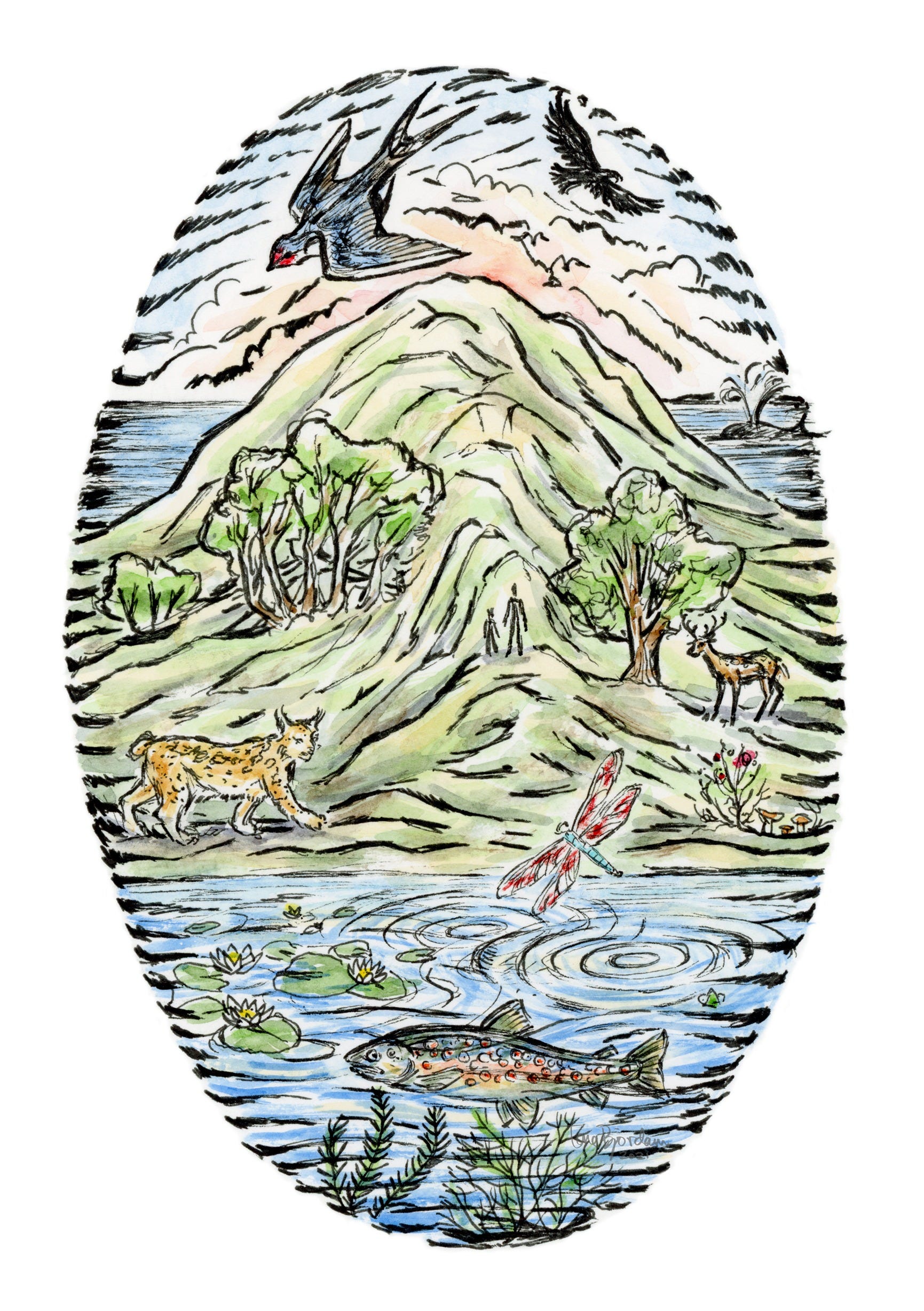
Artwork by Tone Bjordam
Examples
I am often asked what quantum social change looks like in practice. Can you give some examples?
Good question. I understand the importance of real-world examples, but they tend to collapse reality into classical descriptions of “they did this, which led to that, so they did this, and that was the outcome.”
This and that.
With quantum social change, what happens between this and that is what’s important. It’s about relationships and how people show up, moment by moment. It’s about our intra-actions with each other and nature. As nature. Quantum social change is subtle, not causal.
Integrity and trust
How do we identify the subtle dimensions of change processes? The clues lie in patterns, processes, and relationships. Last week I had a conversation with Kerstin Johannesson, the Director of Tjärnö Marine Laboratory at University of Gothenburg. We were on a research boat, and she was talking about Sweden’s first marine national park, Kosterhavet National Park.
She told me it was established in 2009 through a bottom-up process. Fisherfolk and community members were actively involved in the decision-making process and were offered courses in marine ecology. Researchers and policy-makers learned about what local people care about. She contrasted this with the establishment of the nearby Ytre Hvaler marine national park in Norway, which was largely a top-down process that has created resentment in local fishing communities.
My fractal antennas were up — I am always interested in self-similar patterns that repeat across scales. I was curious about the qualities that contributed to Kosterhavet’s success. I found a book chapter by Mia Pantzar that summarizes the lessons from the Kosterhavet case, both in relation to rural development and nature conservation. In between the “this and that” descriptions of what happened, there were references to values like flexibility, respect, reciprocity, integrity, honesty, and trust:
One of the local fishermen explains how his sector was initially ‘furious’ about the plans of a national park, but the fact that the municipality supported the fishermen’s position to keep the agreement from 2000, for which they had worked hard, helped change their standpoint. As fishermen, scientists and the County Administrative Board all sat down together to discuss, they realised that they all wanted the same thing: the park proponents wanted to preserve the local ways of living as part of a sustainably used national park and the fishermen wanted to ensure their livelihoods. ... Coming together brought mutual respect and understanding, enabling an open and honest dialogue — a giving and taking.
I then found a thesis by Mari Reistad comparing the Swedish and Norwegian marine national parks and the role of local participation in establishing them.
Kosterhavet was wanted among local inhabitants, as a way to bring tourists and income to the area. Ytre Hvaler National Park was decided by the government, and had no local support at the beginning. The management of Kosterhavet National Park has higher degree of local participation, with locals being part of the decision-making board in the park. In Ytre Hvaler, the same level of participation has not been achieved.
Reistad’s study found that involvement and participation bring high levels of trust and legitimacy. These are relational processes that take place over time, and they involve connecting what we do with what we deeply care about for all. It involves more than “this and that.”
Conscious strategies
The role of values is often overlooked in examples of transformative initiatives, but they’re always present. And they are consequential. In Envisioning Real Utopias, Erik Olin Wright argues that “if emancipatory visions of viable alternatives are to become the actual real utopias of achieved alternatives it will be the result of conscious strategies by people committed to democratic egalitarian values.” (p. 28).
Wright distinguishes two routes to a systemic transformation of society: Symbiotic metamorphosis and interstitial metamorphosis.
Symbiotic transformations involve strategies in which extending and deepening the institutional forms of popular social empowerment simultaneously help solve certain practical problems faced by dominant classes and elites.
Connecting livelihoods, regional development, and conservation can be considered a symbiotic transformation for sure. But real transformations are often more subtle, or what Wright describes as interstitial. It’s about what happens in the gaps between this and that.
Interstitial transformations seek to build new forms of social empowerment in the niches and margins of capitalist society, often where they do not seem to pose any immediate threat to dominant classes and elites.
Interstitial transformations includes strategies of building institutions of social empowerment that fall below the radar screen of radical critics of capitalism. These, for example, often involve processes and practices that are grounded in integrity and wholeness. In other words, they represent a fractal approach to transformative change.
Many of the marine national parks being established around the world are contributing to interstitial transformations that are changing how we relate to the marine environment. These patterns are not always visible, but they are powerful.
The Power of the Invisible
We may not see the interstitial transformations that are underway, but they are happening. Just because something is not visible doesn’t mean it does not exist. As Dan Siegel writes in IntraConnected, “we are perceptually blind to those systems connections that are outside of our particular mental models of how the world works. We literally are unable to see what is right in front of us.”
Scientists often “discover” something that has always been there. Fractals, for example, were only discovered by Mandelbrot in 1975. Neuroplasticity was proposed long before it was recognized. More recently, scientists have discovered a new circulatory system in our bodies called the interstitial circulation system. “The existence of an apparent conduit between skin and the fascia beneath it — two tissue layers not known to connect with each other in this way — broke accepted anatomic boundaries.”
The discovery of this third circulatory system [in addition to our cardiovascular and lymphatic systems] may have profound implications for our understanding of how the human body works and how we view ourselves in relation to other biological systems.
And yet, the interstitial circulation system has always been there. As an expert in Chinese medicine remarked, “We’ve been talking about this for 4,000 years.”
Why wait?
I worry that if we wait for evidence and examples of quantum social change, it may be another 4,000 years before evidence-based science recognizes and promotes quantum social change. Considering where we are at now with the climate crisis, biodiversity loss, and the state of the world’s oceans, I’m ready to “realize” quantum social change through action right now, including actionless action.
So, over the past month I’ve been uncertain and stuck when it comes to writing this newsletter. I’ve been doing this and that, followed by this and that. However, after running an online course about Scaling Transformative Change, it’s clear that doing what we love, together with those who care deeply about people and the planet, is an example of quantum social change. In other words, quantum social change is love in action.
Once there is seeing, there must be acting.
- Thich Nhat Hanh.
Hi Karen, The following quote struck me:
"I worry that if we wait for evidence and examples of quantum social change, it may be another 4,000 years before evidence-based science recognizes and promotes quantum social change."
What is coming up for me in reaction to this is that waiting for evidence and examples of quantum social change sounds like waiting for the impossible, in the sense that what we're reflecting on here cannot be understood through the mind. It must be felt.
So a sharper inquiry in my view is the following - how do we create more opportunities to weave deeper connection in communities around all that we love so dearly in the natural world? How do we give more folks direct experiences of the magic that is happening all around us, in an attempt to move beyond the perceptual blindness that is driven by our existing paradigms?
I have no nuanced answers in this moment, but this inquiry feels important. And it must be deeply experiential...
Thank you for your writing. I appreciate your reflections in this piece.
This is a good example of why conservation design is not only about drawing the right boundary on a map. The process that creates the protected area can shape whether people accept it. Should local participation be treated as part of the science of conservation, rather than as a separate political step?