
Enough is Enough
Why on Earth are we still treating global geopolitics as if we were playing the old board game Risk? It’s time to stop this risky game and respond with integrity to the adaptive challenges we face.

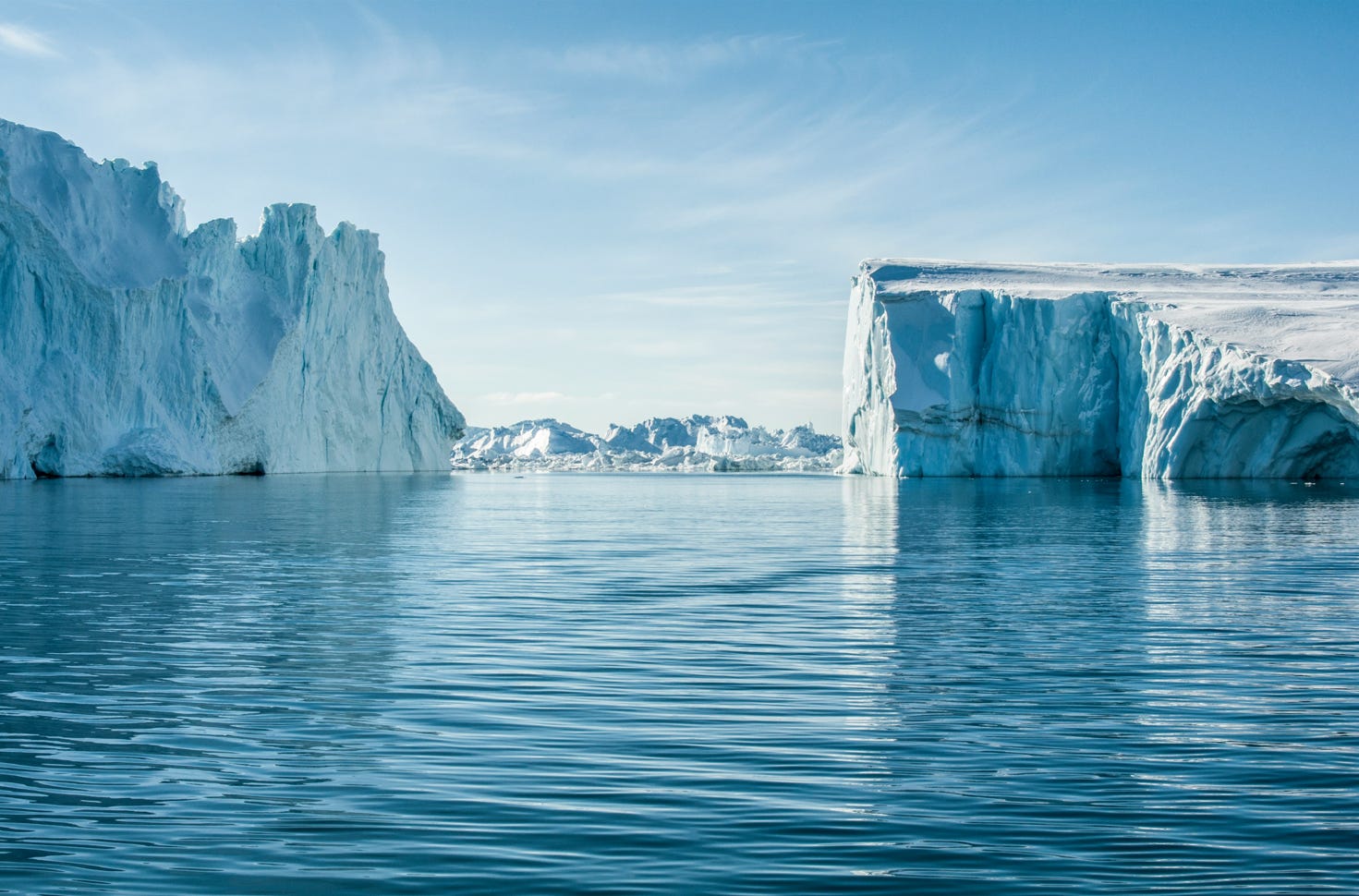
Enough madness
“Enough is enough,” said Greenland’s Prime Minister, Jens-Frederik Nielsen, in response to the U.S. administration’s threats to attack his country. I think most readers of this newsletter will agree with him. We’ve had more than enough of this madness.
The current geopolitical situation reflects an outdated paradigm that threatens us all. The question is, can we move beyond a classical, reductionist paradigm of disconnection and domination and consciously live together with integrity in an entangled, intraconnected world?
The links between politics, power, oil, and minerals are clear. It’s painful to watch politicians and their patrons and sycophants amplifying some risks for strategic gain, while ignoring others. To be specific, the risks of war and climate change.
This situation made me think about a talk I gave at the Our Common Future under Climate Change conference in Paris, which took place in 2015, some months before the COP21 meeting — the one that gave us the famous Paris Agreement.
The topic was managing climate change risks. Risk, as defined in the IPCC Fifth Assessment Report Glossary, is “the potential for consequences where something of value is at stake and where the outcome is uncertain, recognizing the diversity of values.”
This talk feels relevant to the situation in Venezuela, Greenland, and other current threats to international security. The point of my presentation was that we were pursuing an outdated approach to risk and addressing the wrong problem.
An old game
When I was growing up during the Cold War, there was a popular board game called Risk, which some of you may have played. Risk is a military strategy game, where the goal is to occupy every territory on the board and in doing so, eliminate the other players. A high value is placed on competition, strategizing, conquering, and as with most games, winning. The game represents a classical, realist approach to managing risk.
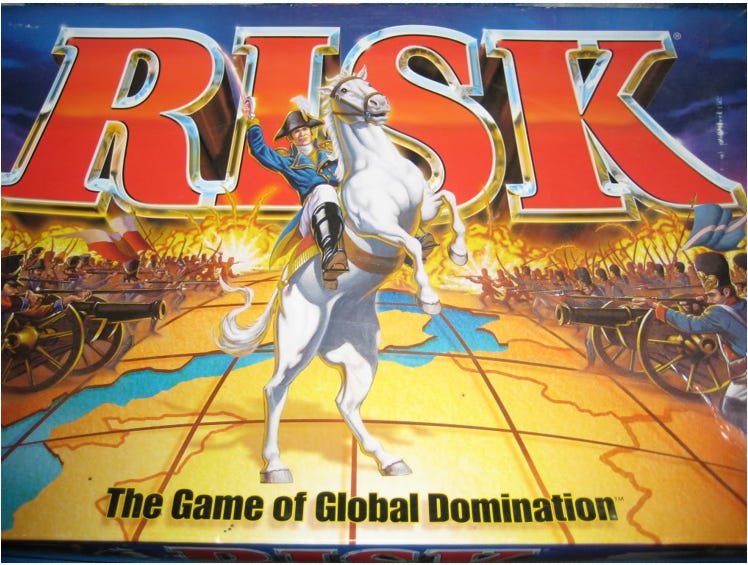
Let’s look more closely at this “global domination” approach to risk. The Risk board depicts a political map of the world that is divided into forty-two territories that are grouped into six continents. In the game, capturing a territory depends on the number of attacking and defending armies. A battle’s outcome is decided by probabilities based on the roll of dice.
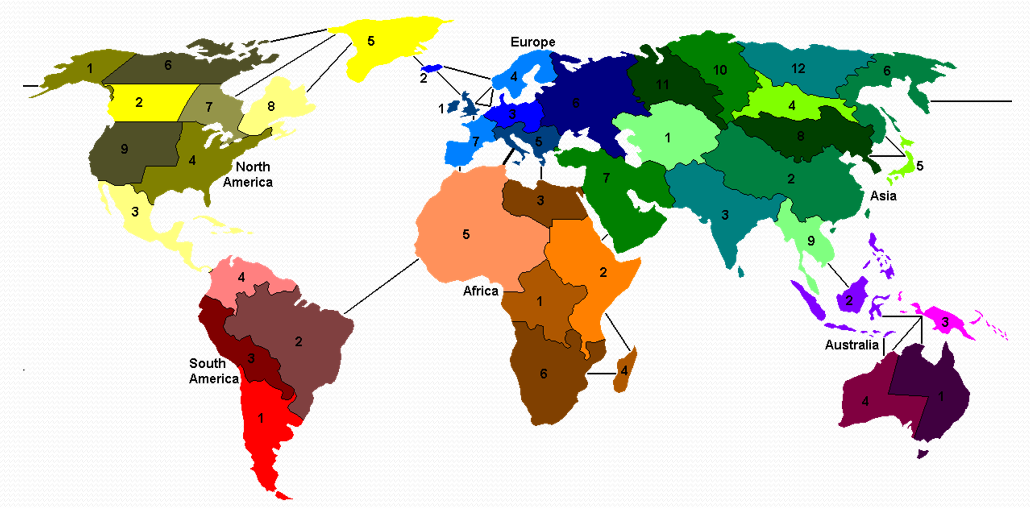
The rules of this game neither endorse nor prohibit alliances or truces – in other words, collaboration. However, according to the Wikipedia description, “alliance making/breaking is considered to be one of the most important elements of the game, and it adds human interaction to a decidedly probabilistic game.”
Adding human interactions to a decidedly probabilistic game becomes even more important if we consider climate change; they introduce possibilities for individual and collective action to change both the game and its outcomes.
Climate risks
Climate change is about risk and probability, but unlike Risk, it’s not a game. As a threat amplifier, it represents a significant challenge for managing all types of risks: we are responsible for these risks, and human actions and interactions play a decisive role in the outcomes.
For example, the IPCC Fifth Assessment Report included two maps showing what global temperatures could look like by the end of this century. Here we see two potential scenarios that were published in the 2014 Synthesis Report: a 2°C warmer world with substantial mitigation and a 4°C warmer world without additional mitigation.
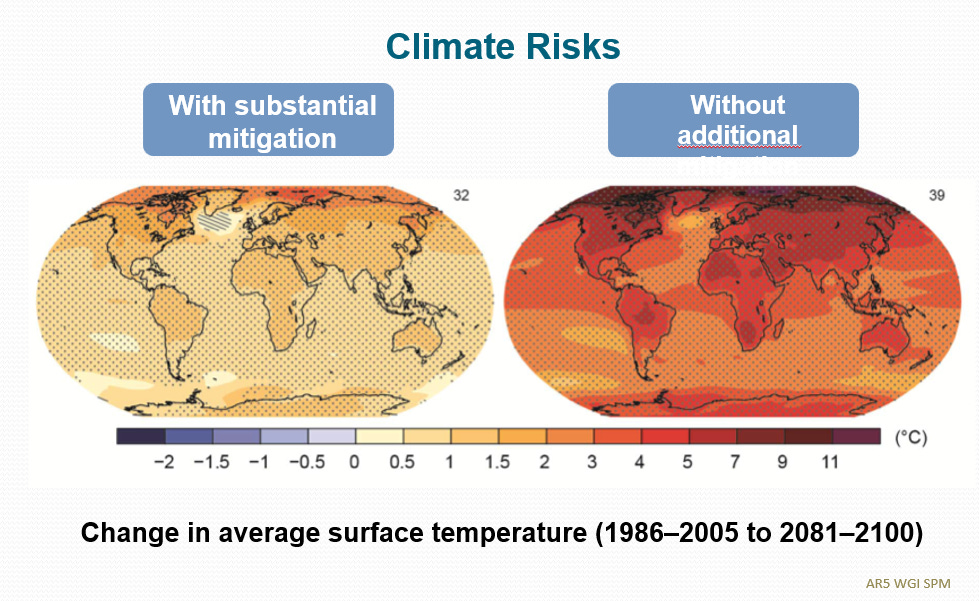
The maps do not include representations of sea level rise, changes in precipitation patterns, the loss of biodiversity and important ecosystems, the uneven social distribution of consequences, and the displacement of people and communities.*
The choices we make and the risks that we take are not just about carbon dioxide and how it will affect temperature, precipitation, and other variables. Risks are also linked to socioeconomic conditions and to changes that shape the context in which we both create and experience risk.
Let’s be clear: the extractive, oppressive, and opportunistic actions that we are seeing today multiply the risks.
The challenge of adaptation
The capacity to adapt is influenced by the rate, magnitude, and timing of climate change, including changes in climate variability and extreme events. Adaptive capacity is also influenced by socioeconomic conditions, including wars.
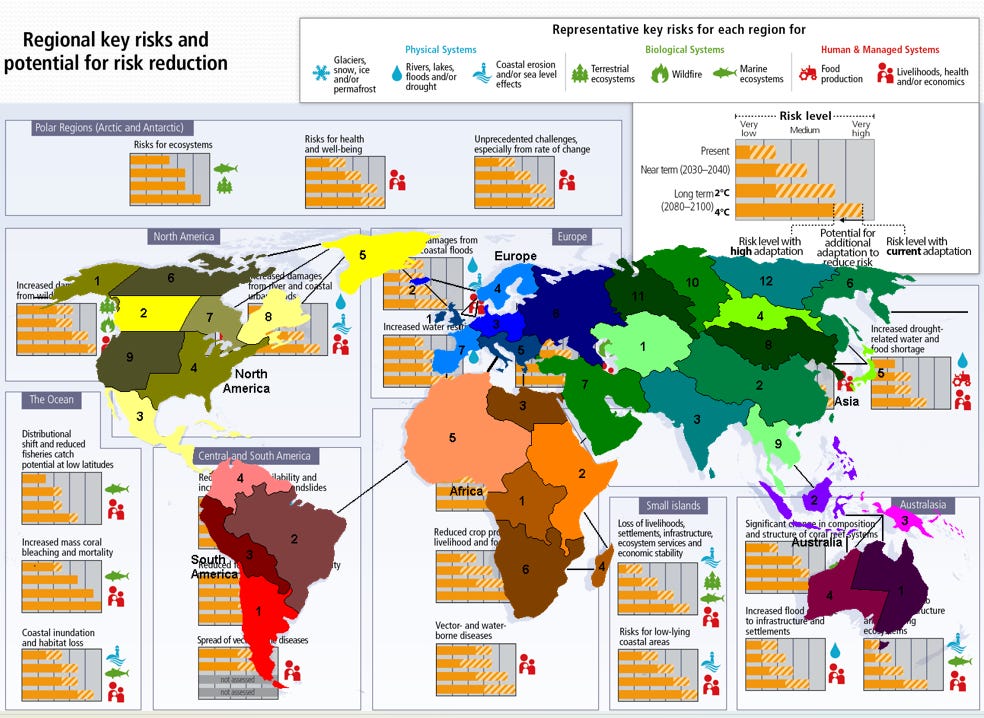
Going back to the IPCC Fifth Assessment Report, Working Group II presented an analysis of regional risks based on both research and expert judgment. It considered the risks over three time scales: the present, near-term, and long-term. Long-term scenarios included both 2°C and 4°C warming.
The figure shows dramatic differences between present, near-term, and long-term risk scenarios. It also highlights the potential for additional adaptation to reduce risk (depicted as hatched bars).
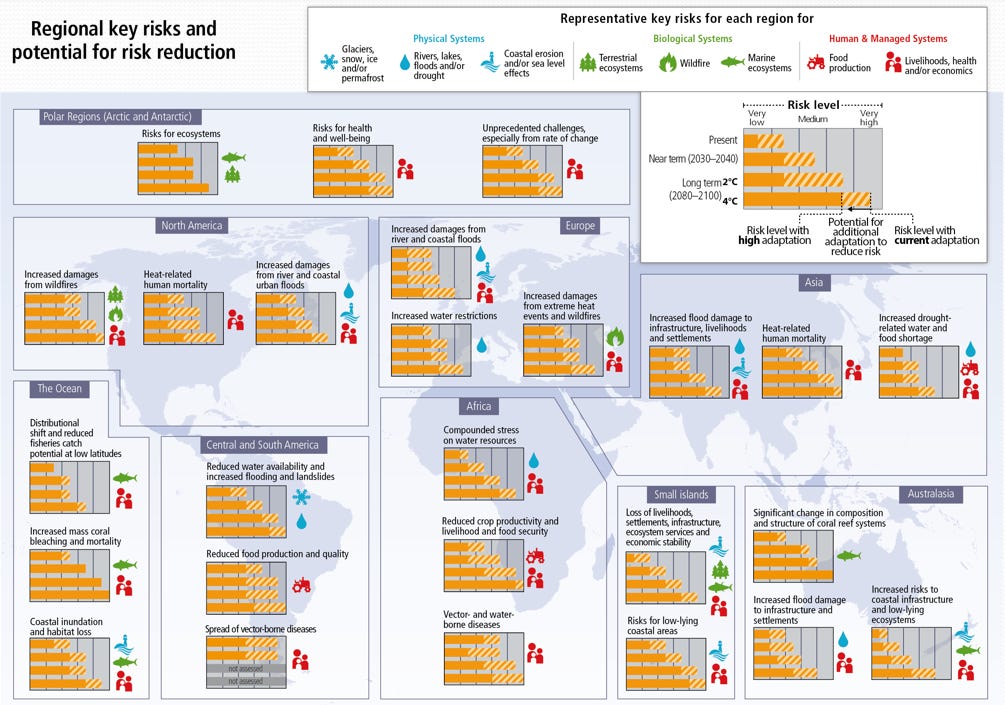
The 4°C scenario shows some very high risks with no potential for further adaptation: mass coral bleaching and mortality, the loss of polar ecosystems, and heat-related mortality in Asia. Even the 2°C scenario poses high risks for many impacts without additional adaptation.
Although Carbon Action Tracker estimates that “current policies in place around the world are projected to result in about 2.6°C warming above pre-industrial levels,” they also point out that “[t]here remains a substantial gap between what governments have promised to do and the total level of actions they have undertaken to date.”
Climate change and geopolitics
Whether in terms of Venezuela’s oil or Greenland’s minerals, if the U.S. and other countries insist on playing the game of global domination, people and nature will end up as collateral damage.
It seems pretty clear that U.S. military action in Venezuela is part of a larger strategy to exploit and burn fossil fuels while deterring the production and consumption of renewable energy.
At the same time, the administration has been defunding and dismantling climate change research institutions like NOAA and NCAR and apparently has plans to continue weakening the Federal Emergency Management Agency (FEMA). With climate change as a backdrop, this is a reckless game that is dangerous for everyone.
Adaptive challenges
We are faced with much more than the challenge of adapting to climate change. There is no doubt that this is important, but it’s often approached as a technical problem that involves building higher bridges and sea walls, breeding drought-tolerant crops, improving early warning systems, promoting innovation, and so on.
As Ronald Heifetz and his colleagues wrote in The Practice of Adaptive Leadership: Tools and Tactics for Changing Your Organization and the World, adaptive challenges are different: they include technical dimensions but primarily draw attention to the beliefs, values, and worldviews we hold, individually and collectively. These shape our identities, interests, and loyalties, as well as how we approach risk.
Adaptive challenges are personal, in part because they require reflecting on our individual and shared beliefs about how the world works and how we relate to each other, our environment, and the future. They are also political: they involve challenging traditional notions of power and recognizing the significance of human interactions and collaboration in managing risk.
This moment
This moment calls for us to stand firmly for equity, justice, dignity, and compassion for all, and to take actions — both small and large — that change the game. This is ultimately a question of what kind of power we believe in and what we truly believe matters. Fortunately, more and more people are recognizing the real risks and, like the prime minister of Greenland, saying “enough is enough.”
Without additional mitigation, and even with adaptation, warming by the end of the 21st century will lead to high to very high risk of severe, widespread and irreversible impacts globally (high confidence).
IPCC Fifth Assessment Synthesis Report, 2014, p. 17
A hazardous situation develops when a nation thinks it has more power than it really has. One theory for the decline of ancient Greece was that it tried to fight wars during a time when its energy, from exhausted soils and depleted forest resources, was declining.
Odum and Odum, 1981
Karen,
This is an excellent essay that thoughtfully puts geopolitics into the broader ecological perspective. A key obstacle to choosing a present and future that's different from the default is the reductive, transactional way that we have come to think as a civilization over the last few thousand years.
When I spent a week at a Club Med many years ago, I was impressed by its slogan: "Too much is not enough." That stands in ironic contrast with Nielsen's "Enough is enough" and frames the dilemma in a clear way.
All the best,
Art
Alas, the funneling of ever more power and money to the oligarchs and corporations in the US lets them structure our world, locking our national policies into their “never enough” mentality, where the only measures that matter are status and material gain. Greed is both original sin and guiding principle.
They are turning our country into a hungry ghost nation, insatiable and blind to everything but the will to power. How could the climate we need to survive be seen as mere collateral damage? This worldview is so bizarre and perverse, I think many of us were almost in shock, disbelieving. But more people wake up with every daily outrage, and more and more of us are getting out into the streets. I just hope we’re not too late.