
Let's Wobble!
Maintaining balance in a chaotic world is difficult, especially when we close our eyes and lose focus on what is important. What if embracing the wobble is our best strategy for transformative change?


My balancing act
I’ve been practicing yoga for a long time, not least because it helps me stay flexible. Over the past year, I’ve been prioritizing balance. My tree pose is getting better and better.
Lately I’ve tried balancing with my eyes closed. Whoa… When I close my eyes, my sense of equilibrium disappears. Without a focus, I wobble. Then I fall.
I’ve been thinking about this phenomenon because it seems an apt metaphor for navigating everything from my personal life to the global political situation.
Personally, I have moved into a new stage of life where I am focusing on “preferment” — emphasizing the qualities and relationships that I prefer for myself and everyone. Changing deeply ingrained patterns is a balancing act. I still say “yes” far more often than “no,” and then I lose focus. I wobble.
Politically, a constant focus on the world’s problems can be overwhelming. At times I want to close my eyes to all that is going on. Ignore the heatwaves, wildfires, melting ice, violent conflicts, and political atrocities.
Why not just focus on the FIFA World Cup, which has been full of good news for Norway?
Yet when I close my eyes to the day-to-day reminders of the gravity of the climate crisis, I wobble. Without focusing on the big picture, it’s easy to become complacent. I can reassure myself that growing investments in renewable energy will solve everything, as if we’re dealing with a technical problem that can be dealt with through more knowledge, know-how, and expertise.
It’s fun to pick up a Norwegian flag and watch another football match, but I tend to keep one eye open. In fact, a friend sent me an eye-opening report about “Football and climate change: A preview of the 2026 FIFA World Cup.” Among other things, this report describes how football has become “central to the petrostate strategy of Sportswashing, embedding fossil fuels culturally in the biggest culture in the world.” With closed eyes, I’d miss the report’s nine policy recommendations for degrowing and democratizing the sport.
What is balance?
The dictionary tells us that balance can refer to a physical equilibrium, as when I stand steady on one leg without toppling over. It can also refer to mental and emotional steadiness, including the capacity to regulate myself and maintain a calm mind and sense of equilibrium. Finally, balance describes a state of equipoise between contrasting, opposing, or interacting elements. For me, this means remaining grounded in what I deeply care about while responding to uncertainty, contradictions, and change.
What I’ve learned from “tree pose” (Vrksasana) is that regardless of my focus, it’s never about being in perfect balance. My muscles and nervous system are constantly working with biomechanics to calibrate, adjust, and adapt. It may not be visible, but I’m always wobbling.
Embracing my "wobble" has helped me appreciate that some of the most interesting intellectual work happens in the both/and space between apparently opposing perspectives. This, too, requires balance.
Navigating the current global crisis is like balancing in a tree pose. It is about having a steady yet flexible relationship with opposing forces. This involves more than biomechanics and technique — it’s also about mindsets and perspectives. In other words, it’s an adaptive challenge.
An adaptive challenge
I’ve done research on climate change as an adaptive challenge, distinguishing it from technical problems that can be managed through expertise. Technical problems often involve doing things better or more efficiently. For example, more solar panels, better batteries, and greater energy efficiency.
Adaptive challenges include technical dimensions, but they are also about beliefs, values, worldviews, and paradigms — the mindsets we bring to a problem. Adaptive challenges ask us to go deeper, reflecting on who we are being and becoming, and why. What might be missing from our perspective? Are we operating from an outdated paradigm?
Climate change is about more than reducing greenhouse gas emissions or building better irrigation and cooling systems. The adaptive challenge includes recognizing that we are contributing to our own risks and vulnerabilities, and that we can consciously transform to a just and sustainable world.
The essence of our challenge is relational. It’s about how we relate to ourselves, each other, nature, and the future. It’s about our relationship to transformative change.
Whether it is related to renewable energy, adapting to heat stress, Artificial Intelligence, or standing on one leg, if we address an adaptive challenge as merely a technical problem, we are likely to fail. And to fall.
The zone of disequilibrium
One figure that has helped me to understand adaptive challenges comes from the book The Practice of Adaptive Leadership: How to Change Your Organization and the World by Ronald Heifetz and colleagues. The figure below, adapted from the book, depicts potential trajectories in facing adaptive challenges.
Adaptive challenges involve tolerating some disequilibrium. This means going beyond our comfort zones and finding the zone where we can be productive, in spite of the distress. We often wobble within this zone. Yet beyond a productive range of distress, when our limits have been exceeded, we fall. We either avoid work so that we feel better, or we treat the challenge as a technical problem.
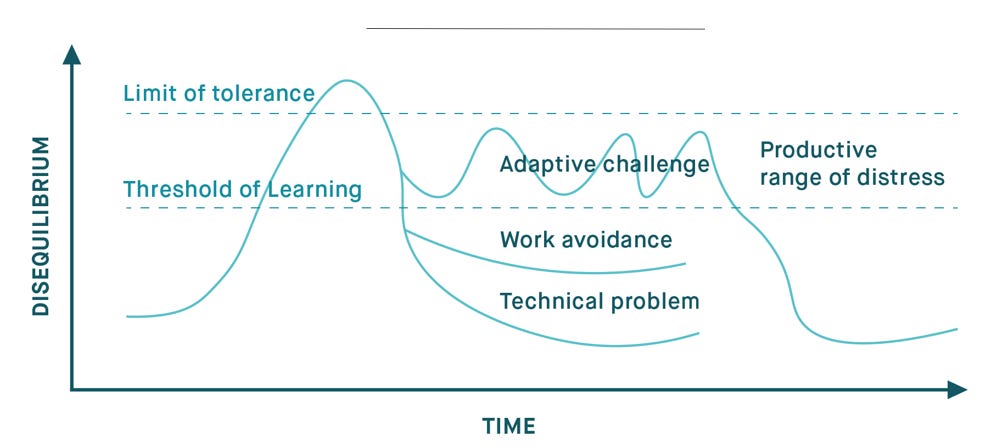
Adapted from Heifetz et al. 2009
As someone who has spent considerable time close to my limits of tolerance, I’ve become an expert at managing that wobbly line and staying within a productive range of distress. At times, I’ve exceeded my limits and fallen into work avoidance. Balancing is a dynamic process, and it takes practice.
What I’ve learned is that the “sweet spot” for operating outside of our comfort zones is never static, and it is different for everyone. The range can widen, narrow, or shift depending on our context.
When I’m tired, stressed, and overloaded — or dealing with a crisis — my zone of productive disequilibrium lowers and shrinks. My creativity disappears and I need to adjust. Adjustments include challenging old assumptions and experimenting with new approaches and ideas. Or resting or taking a break. In fact, work avoidance can be an important adaptive strategy. Yet collectively, we have work to do.
Adaptive challenges are entry points into the dynamic process of transformative change. Rather than focusing on achieving a specific target, our broader goals can orient us and help us to make the many small adjustments needed to move in the right direction, without losing our footing.
Like a collective tree pose, transformative change involves constant wobbling as we take in and adapt to new information. We are challenged to stay within a productive range of distress so that we can stand steady and focus on collective goals.
Let’s wobble!
Over the past decades, my ability to engage consistently with the adaptive challenge of climate change has required continuous learning, reflection, and practice.
Being able to build metaphorical bridges across different perspectives and paradigms has meant being open to new information, ideas, and relationships. Remaining open to the possibilities and latent potential that exist in states of disequilibrium is a continuous challenge.
Yoga has helped me to recognize that balance is the process of wobbling without losing sight of what matters. Wobbling isn't a failure to balance; it’s what balance feels like in practice.
Embracing the wobble may be our best strategy for transformative change.
The engines of distraction are gradually destroying the inner ecology of the human experience. Essential to that ecology is the balance between respect for the past and faith in the future, between a belief in the individual and a commitment to the community, between our love for the world and our fear of losing it — the balance, in other words, on which an environmentalism of the spirit depends.
— Al Gore (Earth in the Balance, 1992)
Karen I love the move in Qi Gong which is Swaying like Bamboo - feet together, apparently still, but in fact swaying slightly. Firmly rooted. A key element ingredients is the ability to sway in the wind.
You might be interested in “Teaching for the Students” by Bob Fecho. Sixth chapter entitled Wobble. Peace. “For wobble, you see, marks a liminal state, a state of transition.” Copyright 2011. I love the analogy, or is it a metaphor? I have wobbled a lot in my life—questioning, questioning.