
That quantum stuff...
How do we invite people to think differently about about relationships to nature, to each other, and to the future? Can a "Climate and Society" textbook inspire quantum social change?

Feedback
“I receive your newsletter, but that quantum stuff goes right over my head.” I always appreciate honest feedback from my mother. Doesn’t everyone?
I have spent a lot of time thinking about how to communicate quantum social change in different ways. It’s not that I want everyone to understand the meaning of quantum physics. After all, nobody really does. This explains why there are so many theories and ideas about the nature of reality, e.g., the Copenhagen Interpretation, the Many Worlds Interpretation, and QBism — my personal favorite.
Instead, I want to raise questions that trigger curiosity about how the meanings, metaphors and methods of quantum physics influence the way we approach social change. I find the relationship between mind, meaning, and matter fascinating, and I love talking about it and writing about it. However, if there’s one thing that I’ve learned over the last decade or so, it’s that most people are not interested. “That quantum stuff” is considered too weird or irrelevant to our social world.
Weird? Irrelevant? At a time of growing polarization, fragmentation, violence, and loneliness, maybe we need to look more closely at the entangled nature of relationships in a way that opens up conversations about possibilities for change.
What’s missing?
My mother was born in 1939, four years after Erwin Schrödinger published his first papers about quantum entanglement. Those papers included his famous thought experiment on the absurd and paradoxical implications of quantum physics for our classical world, which is now referred to as “Schrödinger’s cat.” When my mother grew up, schools were not teaching about the relationship between micro and macro worlds or inner and outer worlds. Back then, the relationship between climate and society was considered through the lens of environmental determinism, which argued that the physical climate and natural environment shaped human societies, cultures, and behaviors.
Has education changed much since then? Well, one big change is that we now recognize that human societies, cultures, and behaviors influence the climate system. Though some still dismiss the science, we know that we are changing the climate in ways that increase the risk of “severe, widespread and irreversible impacts, globally” as the IPCC has reported. The good news is that teaching this to students offers an opportunity to encourage reflections on relationships between the micro and macro, between inner and outer worlds, and between individual and collective change.
Putting this into practice
I’ve been teaching an undergraduate course on the human and social dimensions of environmental change for two decades, and have written a textbook with my friend and long-time collaborator Robin Leichenko. In Climate and Society: Transforming the Future, we discuss the science of climate change, social drivers, impacts, vulnerability, adaptation, and so on. However, we also introduce the students to different discourses on climate change, as well as the role of worldviews, values, beliefs, and emotions. Throughout the book, we invite them to reflect on relationships to nature, to each other, and to the future. We don’t talk directly about quantum social change in the book, but encourage them to be open to new ways of thinking - in other words, to paradigm shifts.
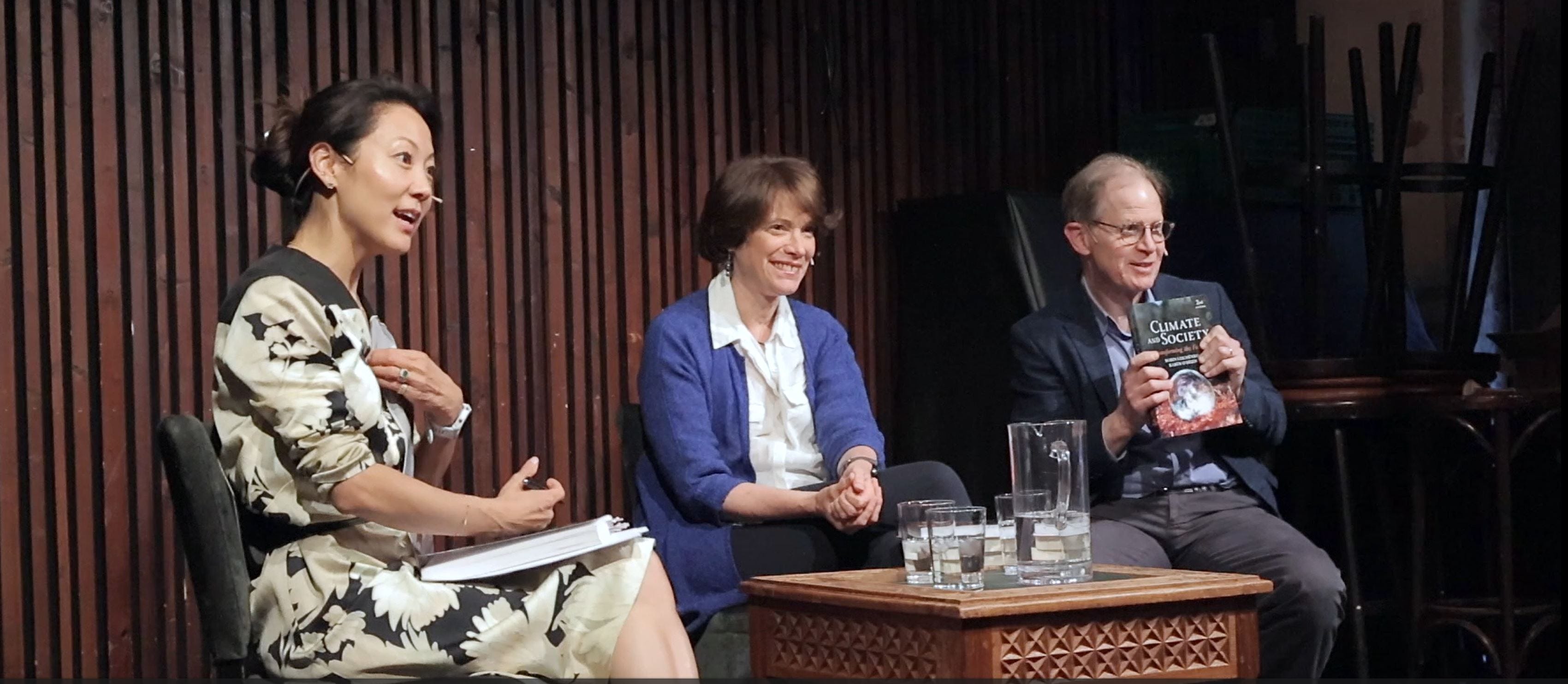
The second edition of the book was published last month in Europe. At a recent book launch in Oslo, I had the pleasure of talking with special guest Dr. Dan Siegel, the executive director of the Mindsight Institute. The discussion was facilitated by Jen Lee Koss, an entrepreneur and investor dedicated to helping women and families.
It didn’t take long for this lively conversation get into that quantum stuff. Dan described the concept of entanglement and introduced the audience to a new pronoun - Mwe (Me and we). We discussed everything from identities and relationships to politics, culture, and agency, including why we matter in the moment. Within the context of climate change action, we talked about grief, trauma, and paralysis - including burnout. Dan led an experiential immersion that took us into a deep dive into how our nervous systems respond to all of this (47:30).
The recording of the book launch is below. I hope you enjoy it — including all of “that quantum stuff”!
Afterthoughts
In The Structure of Scientific Revolutions, Thomas Kuhn observes that “probably the single most prevalent claim advanced by proponents of a new paradigm is that they can solve problems that have led the old one to a crisis” (Kuhn 962: 135). Climate change, biodiversity loss, rising inequality, polarization, and other persistent global problems suggest that the dominant paradigm is indeed in a crisis and that new paradigms are needed. Fortunately, many alternative paradigms are available and contributing to the transformations that are currently underway.
(Leichenko and O’Brien, 2024, p. 224)
Climate and Society: Transforming the Future
Thank you to Diarmid Walker for filming the event!