
The Karma Effect
Understanding cause and effect is at the heart of responsible climate action. Karma isn’t fate but feedback, and a reminder that we matter more than we think.

Climate Change
I’m back in Sarasota, Florida, visiting my mother. The start of the Florida hurricane season has been unusually calm this year, which is good. The political situation in the U.S., on the other hand, is like a Category 5 disaster.
Much can be said about this moment, and many experts are sharing wise words about what can be done to counter authoritarianism and avert environmental and human rights catastrophes.
It’s what is not being said that concerns me.
Freedom of speech and access to information are being drastically curtailed in the United States. Take climate change, for example. The Department of Energy has insisted that employees avoid terminology that is misaligned with the regime’s “perspectives and priorities.” This includes not only the words climate change, but also sustainability, decarbonization, emissions, carbon footprint, and green. Yes, green!
“Countries are on the brink of destruction because of the green energy agenda,” said Trump in a recent speech to the United Nations.
Countries are not on the brink of destruction because of the green energy agenda. It’s the greedy energy agenda that is dangerous and destructive. We are in this situation because so many politicians, businesses, and individuals with vested interests in fossil fuels and factory farming have spent decades avoiding or blocking climate action.
Information still matters
What’s weird is that the media is doing very little to help people understand and respond to the risks and impacts of climate change. Media coverage of climate change in the U.S. decreased by 25% between 2023 and 2024. This was not helpful, given current efforts to dismantle access to public information about climate change as part of a “denial by erasure” strategy.
We know that information alone is not enough to ignite concern about climate change. Participatory approaches and dialogues that enable people to discuss what it means to them have been shown to be more effective than efforts to inform or convince people of its importance. It’s clear that stories can convey strong emotional impacts. Still, if the media does not help us connect the dots, the dialogues and discussions may never take place. Information still matters.
For example, last week six houses on the Outer Banks of North Carolina collapsed into the sea. Videos documented the collapse in real time and showed the waves tossing around the debris. The news stories about collapsing houses described the power of the ocean battering the coast, blamed storms and hurricanes, and highlighted personal stories and emotions of sadness and loss.
The Outer Banks, like many barrier islands and coastal zones, are already vulnerable to a multitude of processes that will be exacerbated by sea-level rise. A study by Sean Vitousek and his colleagues found that “future sea-level-driven coastal recession is expected to increase significantly in tandem with accelerating rates of global sea-level rise.” More specifically:
We find that 63 to 94% of the shorelines on the U.S. South Atlantic Coast are projected to retreat past the present-day extent of sandy beach under 1.0 to 2.0 m of sea-level rise, respectively, without large-scale interventions.
However, with the exception of one NBC report, the articles and videos I saw did not mention any relationship between storm surges, accelerated erosion, and sea-level rise associated with climate change. Even a story in the Washington Post that was in the “climate” section of the paper did not mention those two C words.
This is frustrating because the linkages between climate change and coastal erosion on barrier islands are quite clear, as emphasized in a report by the US Environmental Protection Agency. It’s dangerous because, as Kate Yoder writes in Grist, ignorance can serve political ends.
Yoder quotes science historian Leah Aronowsky’s description of the removal of climate information from government websites: “If you remove it, then in a certain sense, it no longer exists, and therefore, there’s nothing to even debate, right?”
If journalists don’t make the links, people won’t discuss the links. It’s another way to quell climate action.
Sigh…
Reducing “climate anxiety” is often cited as a reason for cutting federal funding for climate change initiatives, including research. Unfortunately, “denial by erasure” adds to my climate anxiety. The images from North Carolina’s Outer Banks are disturbingly etched in my mind for several reasons.
First, it brings back memories of some fun college “beach weeks.” We would drive from Williamsburg, Virginia to Nags Head, North Carolina to party, play, and watch the sunset from Jockey’s Ridge dune. Staying in those wooden beach houses on stilts was a big part of the experience.
Second, it reminds me of talk I heard some years ago by Professor Rob DeConto, who has been studying the impacts of melting of Antarctic ice sheets on sea level rise. DeConto’s recent research shows that long-term global mean sea level rise depends on the timing of mitigation (i.e., the sooner the better), and all scenarios exceed one meter by 2500. No scenario shows recovery of the ice sheet.
Finally, it makes me think about Peter D. Ward’s description of the consequences of sea level rise in The Flooded Earth: Our Future In a World Without Ice Caps:
The effects of one meter of sea-level rise will be massive; three meters will be catastrophic. Incursions of salt into the water table will destroy most of our best agricultural land, and corrosion will devour the electrical and fiber-optic systems of coastal cities, as well as our roads and bridges. Amsterdam, Miami, Venice and other cities might have to be abandoned.
Ward’s book was chilling to read when it was published in 2010, especially his descriptions of the noxious gases that will be produced when vegetation is submerged, and the enormous pollution that will result from coastal flooding of industrial infrastructure.
Denial by erasure is an unacceptable response. The lives of millions of people depend on what we do now. As Peter Ward wrote back in 2010, “There is hope, if we act now. But the train is leaving the station. Perhaps forever.”
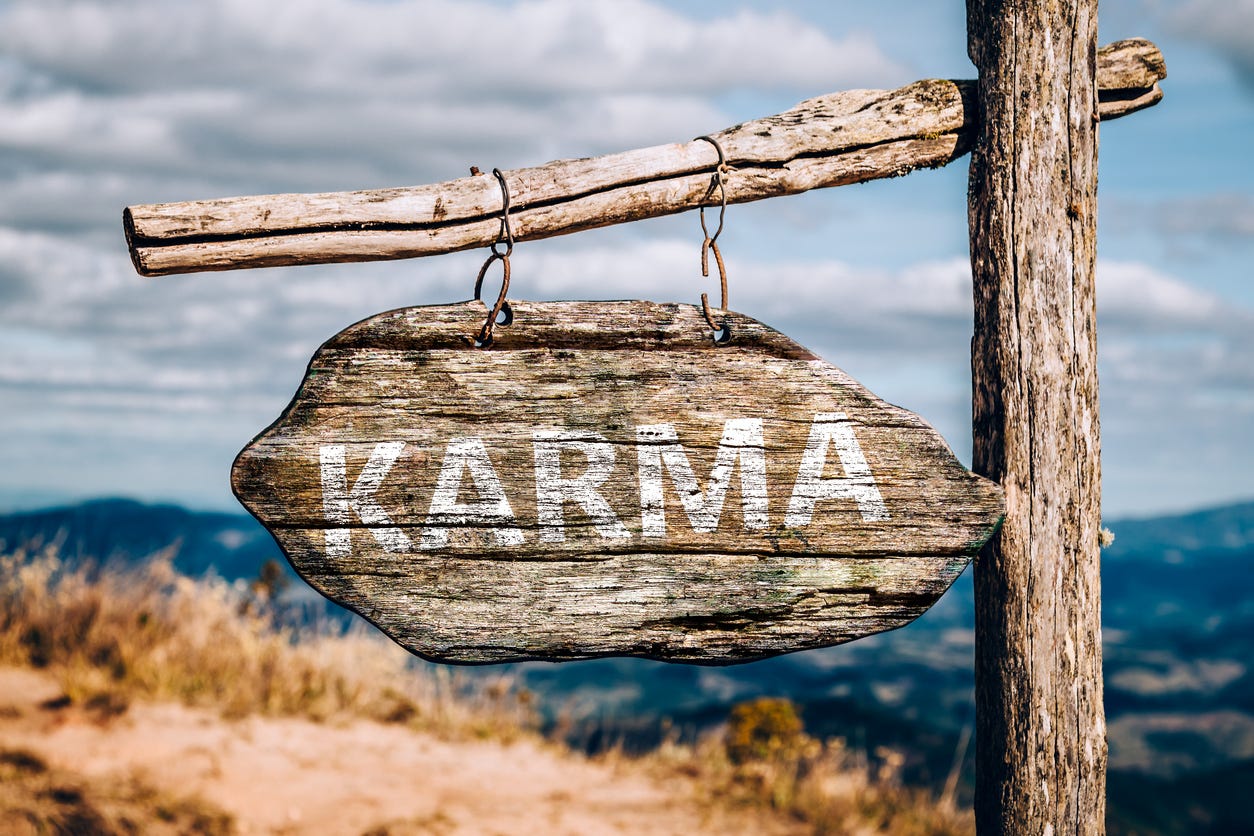
The Karma Effect
So what do we do now? At the end of Rob DeConto’s talk, he mentioned that the Atlantic Coast of the United States would experience early and severe impacts of sea- level rise — I believe he said it was because large amounts of water will be displaced as the gravitational pull of the melting Antarctic ice sheets weakens. He called this the Karma Effect.
Karma is often described as a principle of cause and effect, whereby thoughts, intentions, and actions create future consequences. Karma is neither fate nor punishment. It’s information about entangled processes and relationships that demand our conscious awareness and attention. Karma is feedback.
From the perspective of quantum social change, we are not separate from the reality we experience—now or in the future. As participants, our attention, choices, language, and actions matter.
Like waves on the ocean, we shape conditions on this planet — coastlines included. The Karma Effect invites us to engage consciously with cause and effect, and to take responsibility for the consequences of our actions.
Free speech and access to information are vital to responsible action. Scientists have recently proposed an interpretation of quantum physics that treats information as the most fundamental ingredient of reality. According to the quantum memory matrix framework: “The universe does not just evolve. It remembers.”
It’s important to recognize that climate action and political action are intertwined, and both must acknowledge karma: what we do makes a difference, and we matter more than we think. Speaking of good karma, I’d like to thank Jane Goodall for inspiring me and so many others to persevere for a just and sustainable world. She will be remembered!
“What you do makes a difference, and you have to decide what
kind of difference you want to make.”
— Jane Goodall
We matter more than we think, we matter everything into being 🌀🙏
I've been so immersed in events in Palestine, I've only just got round to reading this! But thanks for the reminder, Karen, that simply being attentive is an action that has consequences.