
The Scale of Things
Fractal approaches to scaling transformations involve a shift of focus, from increasing the extent and reach of "things" to seeing ourselves as pattern shifters.

Scale
Things add up. Buying one plastic bottle of water feels like a small thing; sometimes it is the only option for hydration. Globally, however, we use an estimated 1.3 billion plastic bottles every day. That’s more than 900,000 per minute!
Things multiply. Cutting down a tree may seem like a small thing, but it influences biological diversity, soil, and the microclimate. Globally, the loss of millions of hectares of forests has profound consequences for people, nature, and the climate system.
Things scale. The scale of a problem describes its magnitude, severity, and extent, and to scale something involves patterning according to some rate or standard. When we focus on scaling things, we overlook the fact that that we, ourselves, are pattern-makers. We generate patterns that contribute to both problems and solutions — we are part of the scaling process.
Comprehending Scale
The idea that individual change contributes to collective change and systems change is not easy to comprehend. When we think about scaling, whether technologies, behaviors, or initiatives, there is a tendency to focus on discrete categories and binary opposites such as global versus local, individual versus collective, or top-down versus bottom-up.
Often we either glorify or trivialize the role of individuals in large-scale change. It is easy to recognize renowned leaders and heroes like Mahatma Gandhi, Eleanor Roosevelt, Nelson Mandela, or Martin Luther King, Jr., as agents of change. It is more difficult to see ourselves as changemakers.
In fact, when it comes to creating and addressing complex global problems and their solutions, it’s easy to consider ourselves as too small and irrelevant to have any influence, including on politics and policies. At the same time, many consider individuals with power and authority to be responsible for the systemic changes needed to address multiple and interrelated global problems. Such individuals frequently have competing interests and are committed to maintaining the status quo, rather than to shifting it.
Systemic interventions that foster global-scale transformations involve generating new patterns, such as consumption habits, economic incentives, and investment practices. This includes, for example, shifting from single-use consumer items to durable goods, or moving from tax breaks and subsidies from resource extraction to biodiversity conservation. In terms of investments, new patterns may involve a shift from discounting the future to valuing the future.
How will these shifts happen? Who will make them happen? This is where fractals come in, and why you matter.
Fractal Patterns
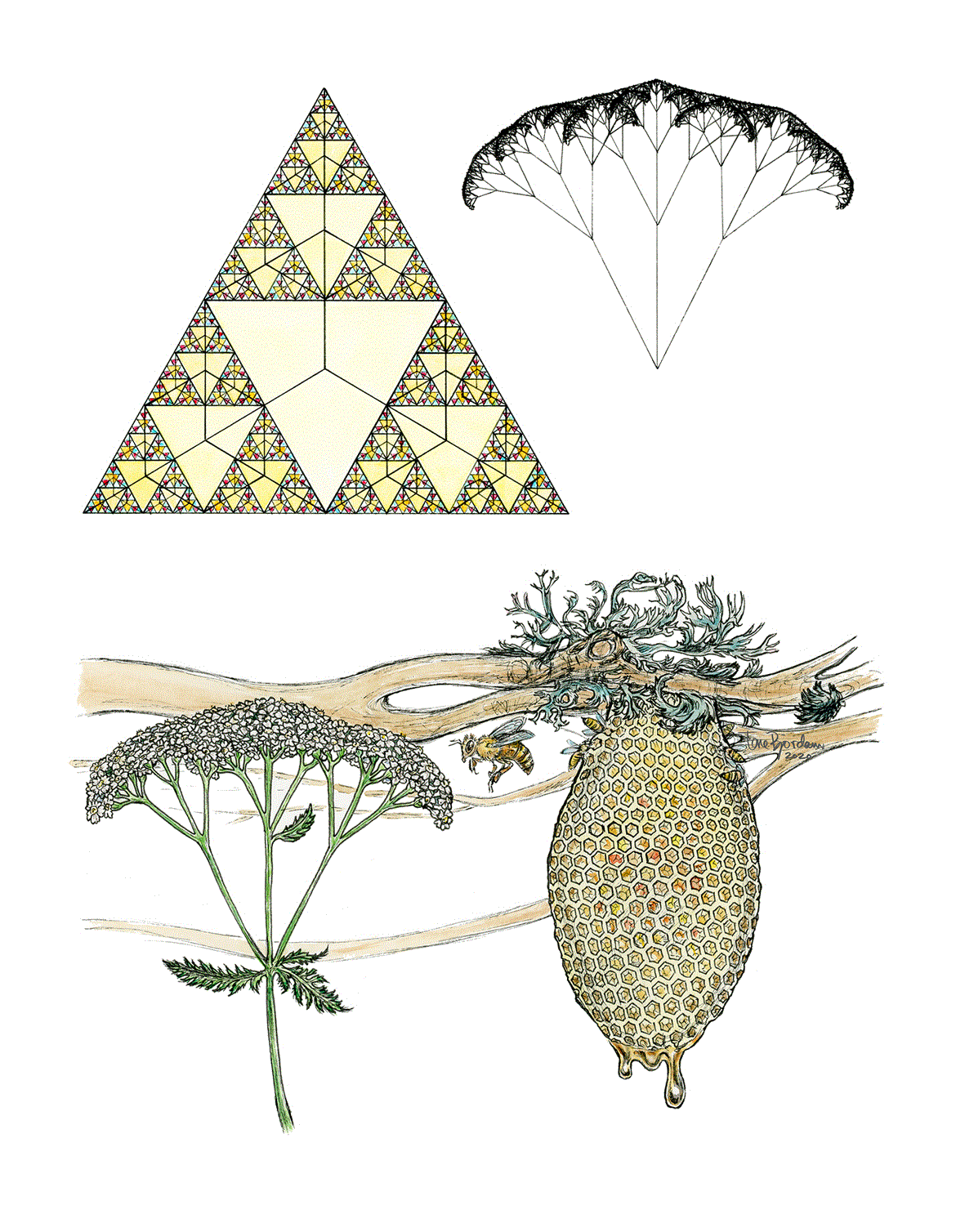
When it comes to scaling, fractals matter. Fractals are self-similar patterns that repeat themselves across scales. However, fractals themselves are scale-free: they appear similar, regardless of the scale at which we are viewing them. Fractals can be generated through algebra or geometry, but fractality is a key feature of the world we live in — it reveals the simplicity, regularity, and unity that lies within complexity. Fractal patterns have been found in quantum material as well.
Fractals address the paradox of scale. Most people now understand that we are each contributing the global-scale problems, but many do not see themselves as part of global-scale solutions. We have a hard time grasping the entanglement and interplay of changes in the practical, political, and personal spheres of transformation, and the difference we can make by doing things differently — across all scales.
In terms of social change, fractals allow us to be “scale free” and to see ourselves as an integrated part of the whole. As we transform, the world transforms. Adrienne maree brown expresses this beautifully in Emergent Strategy: Shaping Change, Changing Worlds, “How we are at the small scale is how we are at the large scale.” Our ideas and practices reverberate across scales. In other words, when it comes to scaling, you matter.
I work with the Three Spheres of Transformation, a framework that brings together the practical, political, and personal dimensions of change. This approach emphasizes how a particular quality of our agency can influence systems and cultures to produce results. Fractal agency is both a quality and a capacity to generate new patterns that strategically transform inequitable and unsustainable relationships across scales.
This approach is based on Monica Sharma’s Conscious Full Spectrum Response (CFSR) model, which when applied to a specific situation is “a fractal of the whole paradigm shift; in other words, each idea, initiative, or endeavor designed as a CFSR response has the same characteristics as the whole.” Her approach includes: “(1) sourcing inner capacities and universal values for action—acting from our oneness; (2) shifting systems and cultural norms, creating new patterns, BEING a principled game changer; and (3) solving problems. And they apply no matter what we do and where we work-at home, in our community, or in an organization. ”
Quantum Social Change
Fractals are fascinating ways to think about the entangled patterns of our thoughts, ideas, words, decisions, conversations, and actions, and they provide profound insights on scaling. I’m interested in the role of fractals in quantum social change — i.e., for conscious, non-linear, and non-local transformations that are grounded in our inherent oneness. What if we were to view ourselves as pattern shifters, and take actions as if we mattered in every moment?
If you are interested in why fractals are important to social change processes, below is an audio of the Fractals Matter chapter from You Matter More Than You Think: Quantum Social Change for a Thriving World.
If you are mathematically-minded and would like to learn more about fractals and scaling, Professor Dave Feldman offers a free online course that focuses on how these ideas relate to complex systems, including urban scaling. The 122 short videos are part of a comprehensive course offered by Complexity Explorer of the Santa Fe Institute. In Lesson 32, Introducing the Chaos Game, Feldman shows how a random process can produce an intricate fractal pattern, as depicted in the artwork above by Tone Bjordam. Amazing!
Beautiful, damn hard, increasingly useful. That's fractals.
— Benoit Mandelbrot